

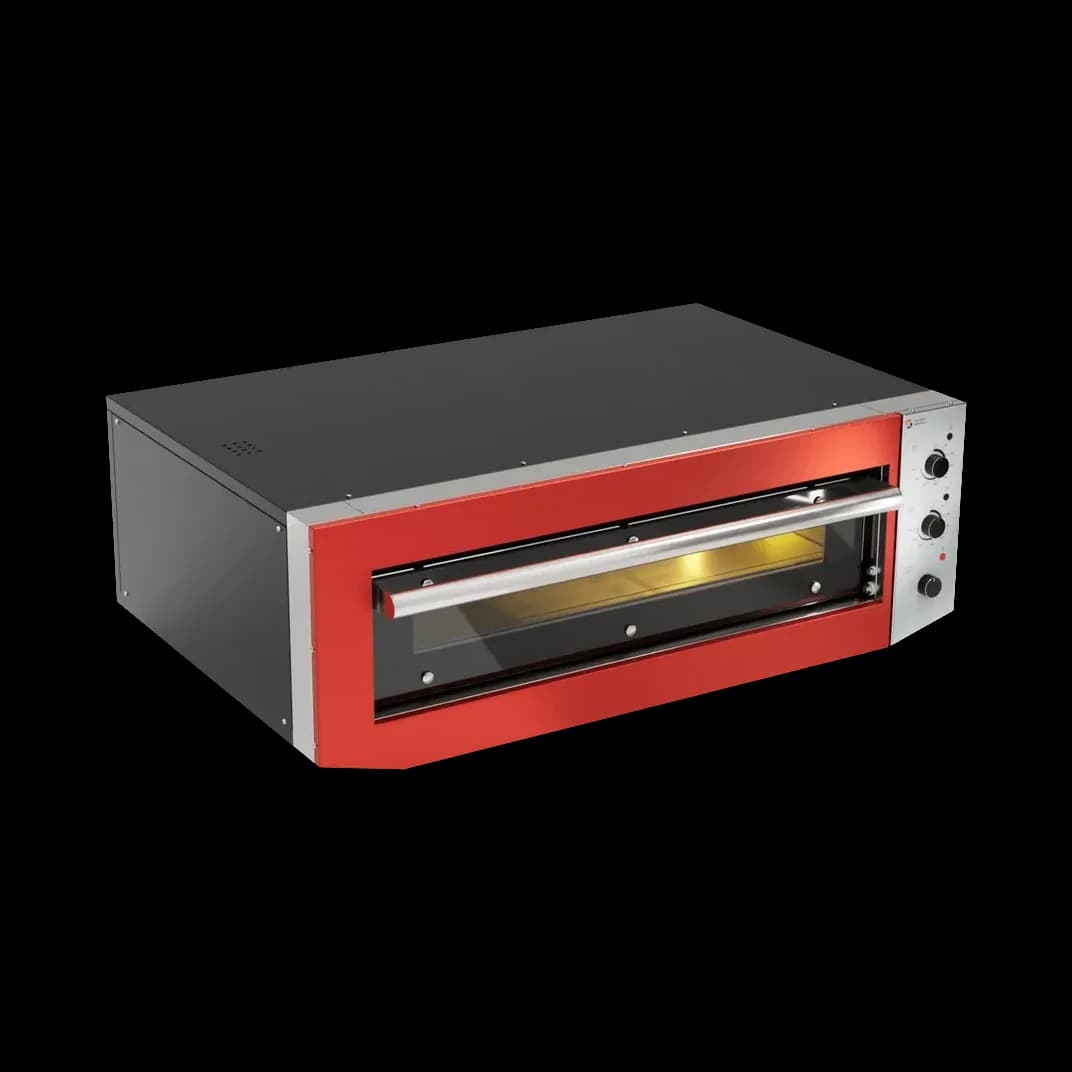
Pizza oven capacity: 4-pie or 6-pie — which one fits you?
Hourly service math, menu mix effects and infrastructure deltas. Field-tested formulas for choosing between a 4-pie and 6-pie oven.
"Do we need 4-pie or 6-pie?" — the most common question
It's the single most-asked question on pizzeria projects. The answer is "tell us your menu and peak hour, we'll do the math" — but that doesn't give you a working formula. This post shares the math we use in the field.
Base formula: how long does one pizza take?
For a classic 30 cm Neapolitan at 450°C:
- Bake time: 90-110 seconds
- Launch + turn: 25-30 seconds
- Pull + check: 15-20 seconds
- Total cycle per pizza: about 2.5 minutes
New York style (260°C, 35 cm) runs 5-6 minutes; gourmet, thick crust or pan pizza runs 8-10 minutes.
Hourly capacity formula
A pizza oven's hourly capacity comes out to:
Capacity = (60 / cycle) × deck slots × utilisation factor
Utilisation factor in the field is 0.75-0.85 — never 100%, because the pizzaiolo pauses to launch new dough or rotate.
4-pie, Neapolitan mix: (60 / 2.5) × 4 × 0.80 = **76 pizzas/hr**
6-pie, Neapolitan mix: (60 / 2.5) × 6 × 0.80 = **115 pizzas/hr**
4-pie, New York mix: (60 / 5.5) × 4 × 0.80 = **35 pizzas/hr**
6-pie, mixed menu (Neapolitan + gourmet): average 4-min cycle → (60 / 4) × 6 × 0.80 = **72 pizzas/hr**
Know your peak hour
For a pizzeria, peak usually lands in a 90-minute window between 20:00-21:30, accounting for 35-45% of the day's orders. So a 200-guest evening with 70-90 pizzas compresses into 90 minutes → you need 50-60 pizzas/hr.
Common mistake: sizing the oven against daily totals. "300/day, 30/hr is enough" locks the kitchen at peak. The right number comes from the peak window.
Menu-mix effects: when 4-pie isn't enough
Three scenarios where we've seen 4-pie cap out:
1. Weekend peak exceeds 80 pizzas/hr — 4-pie practically tops at 70-75 2. Menu includes calzone, pan or 40 cm "family" — these occupy two slots 3. Take-away + dine-in mixed flow — packing + service parallel needs 6 slots
Conversely, 6-pie is overkill when:
1. Under 100 pizzas/day boutique operation 2. Single-type menu (only Neapolitan, 4-5 SKUs) — 4-pie suffices and energy use is halved 3. Tight kitchen — 6-pie + counter + hood needs a 3.5 m line
Infrastructure delta: it's not just the oven
The real delta between 4-pie and 6-pie sits less in the oven price, more in everything else:
Counter and proofer - 4-pie: 1200 mm counter + 1200 mm proofer - 6-pie: 1600 mm counter + 1600 mm proofer (or two 800s)
Hood - 4-pie: 1500 × 1100 mm, 2500 m³/h exhaust - 6-pie: 2000 × 1100 mm, 3800 m³/h exhaust + reinforced make-up air
Electrical - 4-pie electric: 18-22 kW, 3-phase, 32A - 6-pie electric: 28-34 kW, 3-phase, 50A — needs **a dedicated breaker group**
Gas - 4-pie gas: 35-45 kW thermal (DN20 line suffices) - 6-pie gas: 55-70 kW thermal → **DN25 line and larger regulator** required
That infrastructure delta adds roughly 35-40% to equipment cost as an extra line item.
Decision matrix
| Scenario | Our recommendation | | --- | --- | | 80-150 pizzas/day, Neapolitan, single shift | 4-pie electric | | 150-250 pizzas/day, mixed menu | 4-pie + take-away peak management | | 250-450 pizzas/day, peak hour 60+ | 6-pie electric or gas | | 450+ pizzas/day or double shift | 6-pie + 4-pie (backup/peak) combo | | Take-away heavy, packing bottleneck | 6-pie, peak extra slot mandatory |
Conclusion
The answer to "4-pie or 6-pie" lives in how many pizzas you must move in your peak 90 minutes. Share your 6-month forward cover target, add a 20% growth buffer, and we'll spec the slot count and infrastructure together.